Mostrando entradas con la etiqueta English-written. Mostrar todas las entradas

viernes, 23 de diciembre de 2016

Children of the Sea

The fact that I decided to write this review in English must seem ridiculous to most of you taking into account that Children of the Sea has been already published in Spanish by ECC. However, the Spanish edition is smaller than the English one, with poorer quality, printing mistakes and kinda expensive. Furthermore, the publisher has largely ignored their readers' complaints about the moiré effect and continues to print the volumes without any significant improvement. Thus, I've decided to buy it, read it and, of course, review it in English. If you don't agree with me in this decision I am sure you will find plenty of Spanish reviews in other blogs. This said, I can't wait to share with you my impressions on this bizarre but marvelous manga. I am not going to write a synopsis though, since I think it is pointless for such a strange story.


Since I read Witches (Majo or Hechiceras), I knew I would like everything or almost everything Daisuke Igarashi had ever created and it seems like I wasn't wrong. He has a very unique sensitivity which makes all his manga different from everything else I've read so far. Although this story is 100% supernatural, it has so many (accurate!) scientific information about topics ranging from marine biology to astronomy. I already knew several things but there were also a lot which I didn't! I just enjoy learning so much it was impossible I didn't like Children of the Sea. Biology simply fascinates me, the fact that every single being is necessary and has its own niche to colonize, that any (innatural) perturbation can be fatal for the whole ecosystem while the most (natural) violent event, such as a typhoon, is required to keep balance. And I am positive Daisuke Igarashi must love biology too judging by all his works (not just this one).

Actually, this manga appears as an incredibly rellevant read nowadays when there are so many signs that something's wrong in the ocean (well, also in the whole planet but the ocean covers most of it, so...). There are so many marine creatures that are massively dying with little or directly no explanation. Coral is going white everywhere. Chinese are chopping sharks' fins to make soup thus condemning amputated sharks to die in the bottom of the ocean. Marine biodiversity is decreasing dramatically and is expected to continue to do so in the next years. And, at the same time, new research efforts allow to unravel for the first time some of the secrets the ocean still keeps from us. A ghost shark has been filmed swimming for the first time ever, mysterious sea blobs have been genetically identified, underwater animal pollination has been described, submarine structures thought to be human-made have been now discovered to be the result of methane-consuming microbial activity and the the most recent new who directly resonates with Children of the Sea would be the identification of a really weird metallic sound accidentally recorded as a whale call.


Back to the actual manga, Children of the Sea is... just weird. As I said, it is a supernatural fiction where superhuman abilities, extinct creatures and atypical ghosts are its main protagonists. It is mystic, it is philosophical, do not expect a piece full of action and romance because you will not find (almost) any. It is more of an ensemble of monologues about life, and death, and what is in between. The duality formed by Sea and Sky (Umi and Sora), between Earth and Outer Space, marine creatures versus land creatures, how the role organs play within humans may be compared with the role humans play within the Earth and the one Earth plays within the galaxy. And then, it all goes semi-religious going back to the myths of creation, so different and so similar across cultures, with the ocean always playing a primordial role somehow.

As you may be suspecting at this point, Children of the Sea is not a conventional read at all, at first it seems like there is a plot, like that is a beginning, like it will develop following a somewhat predictable/logic/coherent manner. But don't let the author fool you, once you surpass volume two, it all goes so abstract and mystical, any shadow of a plot you could have thought you saw vanishes through the awesome panels depicting all sorts of marine fauna over and over and over again (the fifth and last volume has over 150 mute pages, you get the idea, right?). And that is one of the appeals of this manga, the countless animals the author bothers to draw in each and every one of the volumes, you'll see whales, killer whales, whale sharks, sharks, dugongs, turtles, dolphins, shrimps, nautilus, mantis shrimp, manta rays, krill, eels, and a ton of different species of fish.


Although the characters themselves are so in the background of the real story, that does not mean you won't absolutely fall in love with impetuous Ruka, a troubled girl with social issues who does not adjust with the other kids; sweet Umi, an ever-smiling boy who would rather do whatever he feels like doing before talking too much about it; and elusive Sora, an arrogant and spooky lad with no survival instinct who only seems to care about Umi. This childish trio is further complemented with weird old Dehdeh, crazy old Jim and crazy genius Anglade, who all have their own interests on the children of the sea... and their own personal views of humanity. The thing is that here is absolutely no character who you would rate as minimally sane; thus, empathy is difficult to be found across its pages but that alienation helps with the immersive experience to the fucked up world of Children of the Sea.


Children of the Sea is ultimately a philosophical piece; an essay about what does it mean to be born and what does it mean to die and whether they are so opposite as they seem or they are actually the exact same thing. Just keep in mind the author will only pose the questions, perhaps even develop them a bit, but he will never answer them.

miércoles, 5 de octubre de 2016

Nod

Naïvely enough, I thought that bringing my Wordsworth copy of Tender is the Night & The Last Tycoon with me to my 3-week trip to Indonesia would make the perfect companion for the long airport waits and boat's from-dive-to-next-dive breaks. However, and as I should have realized long before starting the trip, my English is not up to the task of confronting Fitzgerald's writing. After several failed attempts to comprehend Rosemary's dilemmas, I ended up buying Nod in your typical airport book store. If only I had bought it at the beginning of the trip and not a couple of days before heading back to Spain. Funnily enough though, I started reading a book about insomnia just before boarding into a nocturnal jet lag-producer flight where literally everybody in the plane slept but the pilot and me.


Paul watches the whole world disintegrate before his eyes while an insomnia pandemic annihilates all civilization. He is one of the few Sleepers left and thus, one of the few rational observers left to document the end of the world. It only takes around 30 days of sleep deprivation to prematurely die but things start to get pretty ugly way before arriving to that point, facing an accelerated decay including psychosis, aggressiveness and loss of humanity. The Awakened won't stop until the very last of the Sleepers is dead, no matter if most of them are innocent defenseless children.

The idea of what would happen if, suddenly, no warning at all, people became absolutely incapable of sleep felt, as stated in the back cover of my edition, so original. It is a new way to depict an apocalyptic/dystopic scenario where our current society is taken as the starting point (which is not so easy to find in fiction, usually beginning from futuristic settings/parallel worlds). However, before you realize it, the story is not so original anymore and you find yourself reading a zombie book where zombie-like beings, the Awakened, chase the non-zombie-like survivors, the Sleepers.

As an asocial writer interested in etimology, Paul will offer you with endless reflections about humanity, language, society, philosophy, feelings, individual achievement and, primarily, love. As interesting these may be, I would say the few conversations he is able to maintain with Tanya before she is completely gone are more interesting than the monologues he has with himself, echoing the same arguments over and over. The first time he ruminates about how society works, you actually enjoy reading it, but the issue rapidly grows tiresome.

The book is structured as a diary, written by Paul, starting after the first night of worldwide sleeplessness. Actually, the author decided to move forward to the eighteenth day so the first thing we read is the crazy mayhem where Paul is living, not really understanding any of his references to the lollipop yellow, the Admiral of the BlueDemon Park and so on. It was funny to re-read this "first" chapter once I arrived to the 17th day, it all suddenly made sense. The good thing about the messy chronicle is that, although it is full of spoilers, you can't really remember all that incomprehensible data so it does not spoil the book. However, the first-person narrative from the point of view of an introspective writer who lives in a lethargic and apocalyptic world transmits nothing but apathy and disgust to the reader.

And the book is so full of disgusting excerpts, where the author goes back to capital-letters SEX as a mean to make an impact. I was firstly glad to immerse in the brutal and unusual depiction of sex that is portrayed in the first or second chapter of the book as not only is the woman the one who actively wants (and begs) to fuck but the man who has to do it unwillingly, finding the situation so sad and gross he can't get an erection. But... then, the book goes on, and SEX ends up reappearing in a way more horrid portrayal where a woman is, of course, humiliated and used as an object, only to give rise to an emotion in the male protagonist. Actually, although humans as a whole have kind of lost all that made them humans, the author can't help it but make a clear division between zombie-like men and zombie-like women. When Paul encounters them, he shares his thoughts about how the men may had been lawyers, or businessmen, or just finds the male Awakened doing aggressive tasks as killing children while, with regard to women, he just thinks about how pretty might have they been. Even when he describes Tanya, his romantic partner, he mostly focus on her appearance and maternal instinct (which, by the way, prevail among any other thing when she starts to loose it, even though she has no children of her own).

In another vein, the author leaves so many issues unresolved and unexplained. He doesn't even try to find an explanation to what is happening, which is not necessarily bad: it is better to not specify the concrete cause of some paranormal phenomenon than to made up something nonsensical. The problem, for me, is that he can't stop introducing new shocking facts one after the other without pretending to explain any of them at any point and, at the end, is to much to left unanswered. Why would an Awakened pretend to be a Sleeper, why are there so many children who can still sleep, why are they suddenly mute, why all Sleepers share the same dream, why... It all looked random, arbitrary and ambiguous to me.

Conclusion: do NOT buy in a whim a book you have never heard of before, specially not when you are in the other end of the world

P.S. I know I usually quote some of my favorite fragments of any novel I read in my reviews and, don't be mistaken, there were several quotes I would have liked to share here but I am so disenchanted with the end that I'll skip the pain of going through Nod again just to find them.

lunes, 11 de julio de 2016

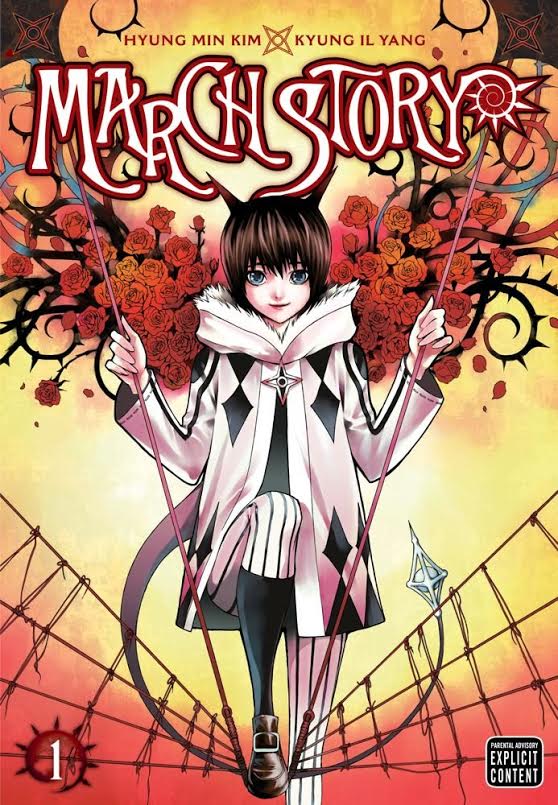
March Story

As a result of the to-read list I published not so long ago, I finally decided to give March Story a second chance before selling it without even reading it trough to the end. Here, I am talking about a manga I bought four years ago, back on the days blogger was full of recommendations of brand-new volumes of titles just licensed in USA. 


When an inanimate object gets impregnated with strong human emotions a demon called Ill possesses it. It doesn't matter whether it is an art piece or a pair of worn shoes, if anyone gets seduced by the whisperings of an ill, he or she will find a bitter and untimely closure. In order to stop them, there are some gifted people who fight the ill and annihilate them, they are called the Ciste Vihad. March is one of them although his mysterious hood may hide some thorns... are those the same that characterize the ill?

As if they were an ill themselves, I was allured by the gorgeous covers of this manga... only to get disappointed by the simplistic characters and the ambiguous plot. March Story is the typical procedural series where most of its chapters are independent from each other with a background story (March's story actually) that gets slowly developed in the first volumes only to become the main plot at the end. I don't really enjoy this kind of stories where dozens of characters are briefly introduced to be dispatched in a few pages ahead since the authors tend to play with extreme caricatures of over-exploited clichés as the rich evil psychopathic tyrant, the spiteful women obsessed with eternal youth or the jealous lad grieving from unrequited love.


On top of that, all of the stories share something in common: endless cruelty and suffering for all characters involved. There is no balance, no rest, no justice... Even the happy endings are bittersweet at the very least. Very appropriately, an explicit content alert is printed in all covers as blood, violence, torture and nudity are all explicitly portrayed in all volumes, with some really sadistic scenes. 

March and Jake being the main characters, they are the only ones with some (very tragic) background stories so the readers can feel pity about them but other characters which I'd say are protagonists as well (or very important characters at the very least, like Rodin) have no development at all... with some really abrupt revelations at the end of the story that felt as meaningless as the side-stories of non-recurrent characters. As I said, everything's so utterly sad, the enormous amount of suffering can only render the readers unfeeling. 


Talking about character development I am jumping to inner coherence and plot development as well, as the issue of the ill is so vaguely introduced and poorly addressed. Ill are presented as blood-thirsty demons that only want to make people suffer and die but there is quite a bunch of these demons that are clearly kind-hearted and akin to humans and there is no explanation whatsoever about why there are such remarkable differences between creatures of allegedly identical nature... which honestly feels like a deep plot hole to me.

Although, as I've already introduced, it was the art style which firstly encouraged me to buy this series, I was fairly disappointed by the inner drawings as they are irregular and disproportionate with some really nice close ups but with so many characters where it is obvious that the artist didn't care too much... clearly illustrated by the ridiculously enormous design of Jake who is supposed to be a charismatic character but whose dimensions were distracting me through her whole story. The artist seems to be influenced by several places and studies, with a kind of European setting, with castles and so on, characters and scenes that strikingly resemble some famous productions from Ghibli Studio too; this random mix makes me wonder how inexperienced was the artist when creating this story as everything seems so arbitrary. He gets so lost with precious objects and their details although, when thought about it, they are just unpractical. Furthermore, battle scenes are so difficult to follow and always end prematurely with remaining scars as the only testimony that any damage was done (mostly scars that don't fit the actual weapons used in the battle...).

Air dancing by Sophie and Howl set in Venice
In summary, I was pretty excited with the idea of reading these series and I don't understand what it is that made it popular: not the art style, not the plot, not the characters. If you deliberately want to suffer, it may suit you. If not, just stay away from it!

lunes, 30 de mayo de 2016

Wrecked Hearts

As you may already guessed, since I discovered crowdfundings and, specially, Kickstarter, I've been wasting a substantial amount of money backing several comics now. However, this is the first time I've decided to review one of them here... why would that be? Well, it is actually the first crowdfunded comic I've backed to date that has arrived in its physical edition within the estimated delivery schedule. It happens to be also the only crowdfunded comic I've backed that I've actually read once on my hands. And, last but not least, it is just incredibly amazing.


Wrecked Hearts includes two independent stories whose only connection is that they are both set on the outer space. First, Luca Oliveri introduces The Real Thing where Fio has an erotic dream with a classmate. Nothing so special about it except that Fio is a girl and in her dream she was a boy. Still, that wouldn't be that remarkable either if it weren't for the nature of Fio, whose father is an alien and who can actually metamorphose into anything, the opposite sex included! Unfortunately, she has been strictly forbidden to transform into anything nor anyone than her true nature, which gets her too frustrated. Finally, she decides to transform into a guy in the upcoming school trip, in order to get close to Roman (her crush) and materialize her fantasies. You will have to buy and read the comic to find out if she accomplishes it!

The Real Thing perfectly fits into the classical shôjo structure while introducing a bunch of extra features such as sci-fi jargon and setting and a hermaphrodite teen protagonist with ambiguous sexual orientation. The universe created for this story is interesting itself, with space hockey played over the frozen surface of some uninhabitable satellite and casual references to current human history and culture such as Gundam and health issues of present astronauts. The concept of an alien species with the ability to metamorphose is not that innovative, the fact that the author fuses both of them into a romantic teen comedy makes this story so hilarious and enjoyable. Fio is so reckless it makes the reader laugh and the art is really gorgeous, clearly influenced by manga aesthetics but with a notable European background too. Furthermore, this story is in full-color! I didn't really know before opening it (or maybe I just forgot but the surprise was the same) so it was great to discover.


The main cons of this first comic would be it is way too short (only 40 pages), precipitate and with an open end, which reminds me of one-shots or yomikiri, which typically give rise to longer and serialized stories in the same magazines. Continuing with the Japanese dynamics, the onomatopoeias are written in Japanese which makes no sense to me but maybe was made in purpose to resemble manga even more. But what upset me the most was the lacking consequences of Fio's deception, since she hurt Roman (resulting in the first wrecked heart) and not only did she not apologize but was Roman who did it. Also, the whole story is so innocent that it hurts me to actually write it down but one of the scenes gets dangerously close to sexual abuse, even if it's intriguing to watch gender's cliches switched. Of course, The Real Thing is a comic about boundaries and their ambiguity so no wonder Luca decided to tackle not only theoretical ones but physical ones too.

Later on, Mathilde Kitteh presents Dark Energy where the goddess who created the universe is tired of passively observing how every living creature falls in love and has its happily ever after with its loved one so she decides to become human in order to be gifted too by the feeling of love. Of course, being immortal, she will encounter lots of love but also lots of sadness as she goes losing everyone she loves to the point she forgets who she actually is. At this point she locks into a space ship where only plants keep her company. That's when the semi-android journalist Mikael meets her, in order to visit her greenish ship and write a book about it afterwards.


Astrée (which, by the way, comes from the French astre, which means star, with an additional "ée" ending which typically transform nouns into feminine adjectives) and Mikael are the loveliest of the bizarre outer space futurist supernatural couples. Although the main plot would be the romantic one as part of the Wrecked Hearts topic, there is room for sci-fi unfolding same way as Luca developed in his story. Instead of cool futuristic adaptations of current sports, Mathilde prefers alien and technology-driven speciation including androids (as the male protagonist), ever-farting clouds and a range of tiny talking plants with witty names. Here, Astrée has to confront her inner demons and accept who and what she is. Although Dark Energy is considerably longer than the former, the story also feels dramatically hasty with a marked sprint at the end that rapidly results in bitter closure.

Both stories are clearly influenced by Japanese comics in terms of structure, sequential narrative, drawing style, with The Real Thing echoing shôjo and BL frameworks while Dark Energy kind of resembles Ghibli universe as the protagonist reminds me of classical anime heroines as Nausicaä, Chihiro or Princess Mononoke in their characteristic alienation from humanity, broken heartedless and genuine kindness, which they all share with Astrée.


I have really enjoyed discovering the outer space diving into these intimate tales, overflowing with human conflicts from a slightly romantic coded view. I definitely recommend Wrecked Hearts to all shôjo and sci-fi lovers and I hope Peow Studio will continue to rely on Luca's and Mathilde's talents in further publications! I am positive I would back them again. 

martes, 21 de abril de 2015

Garden Dreams

It's been a while since I made you suffer with my robotic english for the last time. I tried to exploit the last holidays for reading a small percentage of the tons of manga that keep getting wasted dawn in my basement and deep into my closet. This time, I rescued a one shot by Fumi Yoshinaga, who you may know because of her awarded and ongoing series Ooku: The inner chambers. Garden Dreams contains four short stories settled at an era which may correspond with Victorian England.


Farhad lost both his parents as a child in the middle of a war, he certainly would have died if it weren't for Saud, a young man who rescued him in the desert and adopted him. They have been traveling as bards, singing and playing the lire to make a living, ever since. One day, Farhad and Saud end up in a western land lead by Baron Bianni, a sad man who also carries a mournful past...

Although this volume consists of four independent stories, they all fit perfectly in the same story-line. This may not appear obvious from the beginning but as long as the story goes on, the pieces start to connect. All the main characters share a tragic background and have suffered because of the deaths of their beloved ones, either their parents, their children or their lovers.

One of the strengths of Garden Dreams is that even when they all have encountered with similar tragedies, they all react very differently in a sort of "you can not chose what happens to you but how you react afterwards" moral. Victor isolates himself into his castle despising his own life, Saud feels an unbearable guilt and blames himself for the fate of his offspring while Farhad simply accepts his past and moves on, ready to love and to be loved.


I've been kind of confused with the sexual orientation of the characters since two out of three main characters seem to be bisexual and even though I know that is plausible, I find it too convenient to the plot and slightly out of context taking into account the time-space setting of the story. On the other hand, I've got used to this ambiguity when it comes to manga. It is just another cliche to add to the list.

Regarding the art style, I'd say irregular. Overall, it is beautiful enough: the simplicity of Yoshinaga's lines and absence of background are gorgeous at some panels, but still it appears clearly to me that Garden Dreams (1999) is the work of an inexperienced mangaka. In fact, it wasn't until someone referred to Farhad as a "son" that I realized that he was a man and not a woman. I guess that may be due to the author's devotion to yaoi genre in which is not that uncommon to find feminized ukes. And no, Garden Dreams is not yaoi nor BL!

I guess I just was too hyped by later work of Fumi Yoshinaga, Ooku, and by a handful of fans who encouraged me to buy a copy of this title that it is not that surprising that I felt disappointed. I am not saying this is a bad comic but just that such a melodramatic argument does not work for me (anymore). In fact, I find it slightly insulting to deal with life and death with so little concern...

miércoles, 15 de octubre de 2014

In Clothes Called Fat

I really love Moyoco Anno's work, even when she is able to draw stories so opposed as the sweet and shiny adventures of the young witches of Sugar Sugar Rune and the brutal +18 rated memoirs of a prostitute in Sakuran. I've never encountered any such mangaka with the ability to hit you so hard with her vignettes. She goes really deep into human faults: envy, arrogance, greed, lust... reviewing all capital sins in barely 250 pages.


Noko Hanazawa is fat. She is not awfully fat nor anybody could consider her anything near obesity but, when compared to her skinny coworkers, she does look plump. She has a weak personality and has get accustomed to the discriminatory treatment she receives at work but everything will be OK as long as her boyfriend Saito keeps caring for her. Nevertheless, when she suspects Saito is cheating on her with one of her annoying coworkers, she gets so stressed she can only feel at ease when eating compulsively...

Eating disorders are one major health issue in developed societies. Extensive attention has been paid to anorexia nervosa and bulimia nervosa, which is slightly depicted in this manga. But one major disorder that seems to get lower attention in the media is binge eating disorder. I get the feeling that these disorders get biased attention from the community out of discrimination. Extremely thin teenagers who end up needing parenteral nutrition surely look more pitiful than obese people. I recently digressed about mental disorders and how society tends to stigmatize people with schizophrenia. The same applies to binge eating disorders, which hold a category in the DSM5, the Diagnostic and Statistical Manual of Mental Disorders. In this regard, Moyoco Anno is a sort of pioneer addressing thorny and avoided themes such as japanese prostitution (as she did in Sakuran) opposing to the more glamorous and commonly dealt issue of geishas.


Moreover, the author drops some disturbing concepts in this manga beyond eating disorders and beauty standards. She tackles workplace bullying, either by bitchy coworkers or incompetent bosses who need to intimidate weaker people in order to feel good with themselves. I do not know if I'm too naive but I'd rather think there is no such people as Tachibana in real life. In fact, all characters are hopelessly twisted and/or docile leading to really creepy and cruel scenes (a little spoiler here to illustrate this insane sadism: at the end, after Saito breaks up with Noko, Mayumi recognizes she was only interested in Saito because he was dating Hanazawa and he allowed her to indirectly torture Noko; how fucking sick is that!).

Anyhow, I believe the major concern depicted in In Clothes Called Fat is lack of self-esteem. It doesn't matter whether people think you are ugly or fat or stupid, if you are not capable of accept yourself, it is impossible to do so for outsiders. And that is exactly what happens in the story: Noko can't stand the disdain, so she eats compulsively; Noko can't stand herself being so fat so she turns out bulimic; Noko has finally lost a lot of weight but, still, she continues vomiting because she is not happy.

Moyoco is kind of cunning here. It will be very easy to portray Noko as a victim of modern society/bad people/you-can-choose. But she splits the blame among all characters instead; and that makes Noko guilty too. The boss is at fault because he was unfair, Tachibana is at fault because she is a bitch, Chika and Yoko are at fault because of their hypocrisy and indifference, Saito is at fault for psychologically abuse Noko and for demanding her to be fat in order to feel superior, Tabata is at fault for being so hateful, but Noko is mostly to blame for being so weak and mindless and for having so low appreciation of herself.


The art of Moyoco Anno could be qualified as unaesthetic and it may shock some readers when browsing the volume for the first time if you are not familiarized with her. But I think that her style is gorgeously adequate: it fits with the horror behind this manga. I often encounter super cute drawings in shôjo titles but their respective mangakas are usually incapable of depicting either ugly, fat, old or, in short, not stereotyped characters and, when they try, they achieve nothing but unrealistic drawings who do not match with the young and pretty protagonists.

In conclusion, I really encourage you to read this comic. Furthermore, since the fiasco of both Sugar Sugar Rune and Hataraki Man prints by Glénat/EDT, I believe there is no single spanish publisher interested in licensing any of Moyoco's work anymore so... read in english. It is worth a shot.

sábado, 20 de julio de 2013

not simple

not simple has been my first approach to Natsume Ono's work. I was somewhat interested in this author due to the insistence of @DarKraD_10 and, finally, here I am, ready to review one of her unitary volumes. And, sincerely, I don't know where to begin.


The volume is organized in twelve chapters plus a prologue and an epilogue, being the prologue the first thing you read but the last one on the timeline; so the reader knows the end of the story before it has even started.

Ian is a young kid whose elder sister Kylie is in prison while their parents get divorced and he is forced to go living with their alcoholic mother in London. When Kylie gets out of prison and knows about the location of Ian, she decides to go and steal him but by the time she arrives it could be too late for Ian... Their story will go through a lot of turns making the main plot of the volume the attempt of both brother and sister of being together for good.


Natsume Ono torments each and every one of her characters making up a really harsh and cruel story. I could expend countless hours wandering about all the suffering that saddens Ian or Kylie or even Jim but is useless. not simple is this kind of story which makes you feel really sad and depressed and leaves an unpleasant feeling that remains although you already have finished reading it hours or days ago. And knowing what is gonna happen in the end, makes the whole story even more depressing.


In its barely 300 pages, the author manages to talk about sexual abuse, parental abuse, homosexuality and its acceptance, child abandonment, death (either assassination, suicide and natural death) and pursuit of goals and dreams. I rather say that I hate those stories where a terribly huge number of coincidences make unfortunates their leading characters, and not simple is one of those. Nevertheless, Ian is always fighting and confronting each setback with a smile in his face totally blinded by its goals. So, not simple is somewhat a lesson of positivism in a certain way.


Regarding the art, just by looking at the covers of other Natsume Ono's works you can realize she has a really particular style. Some people could see it like an ugly art style but I really love these giant-headed characters with very geometrical features. It is not like the drawings could disturb you from continue reading the volume, so I think it's OK to have a very characteristic style that points out that much.


So, my final verdict is that not simple is a really sad story where you would end hating so much Natsume Ono but appreciating her at the same time because of her capacity of getting inside you and make you feel like that with just some weird drawings. Highly recommendable only if you can tolerate tragic stories well.

viernes, 28 de junio de 2013

Utsubora

Since Utsubora is published in english and I just want to encourage people to buy it and support Asumiko Nakamura's work, I've decided to write this review in english for the very first time in my blog. So, I apologize in advance both to my usual spanish followers and to new incomers that may have some difficulties with my non-native english. Once this language issue has been clarified I can start with the review itself.


Utsubora is the only manga by Asumiko Nakamura that has been published in english to date. It came out the past June 20th by Vertical collected in one single volume of 460 pages.

Shun Mizorogi is a bestseller author that suddenly has to face with the suicide of a young woman called Aki Fujino. Aki was the real author behind the curtain and the latest and popular novel of Mr. Mizorogi, Utsubora, is actually hers. When called by the police to identify the corpse, Mr. Mizorogi meets with the unkown Aki's twin sister, Sakura Miki. Mr. Mizorogi will find himself inevitably attracted to her... while the police investigates the strange circumstances in which Aki Fujino's death took place.


Utsubora is a perfect choice for people who has become bored of typical manga comics. I think is a story about obsessions. Every single character of the book is actually obsessed with Mr. Mizorogi while he is obsessed with his books and nothing else. This kind of unilateral feelings lead to a slight despair. Obsession and despair. This is the exact cocktail that characterizes Utsubora.

In its 460 pages Utsubora covers a number of topics from suicide to love going into the reasons for living in a certain way. However, the main plot of the story remains in who is Sakura Miki and who were Aki Fujino. A parallel investigation between the police and Mr. Mizorogi himself accompanied by several flashbacks of the supposed twins make the reader immerse into the disturbed world of Aki Fujino, whoever she is.

What I was saying about despair
But, at the very end, the mystery of the real identity of Sakura is not what Nakamura wants to reveal. In my opinion, it is not even clear and all you can do is guess what happened exactly between Aki and Sakura (or maybe I am to dumb to understand the plot) because the author is never telling you the truth in a simple way. But what Nakamura really lefts behind in the pages of Utsubora is a lot of unrequited love, a considerable amount of sadness and desperation and tons of madness.


Utsubora has been rated for 18+, death is so omnipresent throughout the story to be surprised about it but I think that this warning is more about the sex and luxury scenes that adorn several chapters, contributing in the crazy inner world of the characters.

To end this review I just want to emphasize the beautiful and distinctive style of Asumiko Nakamura: the cleanest white and black sketches with huge otherworldly eyes that make female characters stand out.

It had been so long since the last time I enjoyed a reading so much. Asumiko Nakamura totally catches you in the middle of her story and you can not drop Utsubora until you have turned the last page. And then you can go and crush your head against the wall trying to realize something that makes sense.